The Tarot Cards, Photographs, and Alchemical Emblems Used in The Great Gatsby
The Tarot Cards as Emblems
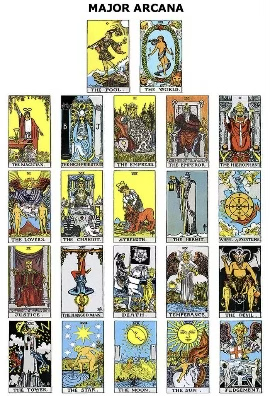
The Great Gatsby uses 34 of the 78 Tarot cards. Carl Van Vechten’s The Blind Bow-Boy employs 12 Tarot cards. The cards are used by both authors to mark the passage of their initiate-protagonists on their spiritual journeys. Fitzgerald departs from Van Vechten in that he uses some of the cards twice, once using the upright divination and once using the reversed divination. In The Great Gatsby the meanings of the divinations bear close parallels to what happens in the novel more so than in The Blind Bow-Boy. When a wheel comes off a car at the end of one of Gatsby’s parties the card indicated is the Wheel of Fortune, and when the drunken driver says “Put her in reverse,” the reversed divination is indicated. A more salient innovation in Fitzgerald’s use of the Tarot is that he allows the Tarot to emerge into the surface text with Gatsby’s White Card. While in the story the White Card seems to function as a business card that connects Gatsby to a local police commissioner, the White Card expressly belongs to the Tarot deck. The original classic Tarot deck consisted of 78 images. Some manufacturers added a White Card which became very significant for the interpretation of the Tarot spread. This card is called the card of the Absolute and of the Higher Powers. The White Card has two functions in Gatsby: it links Gatsby to the Absolute, while also declaring the presence of the Tarot in the novel.
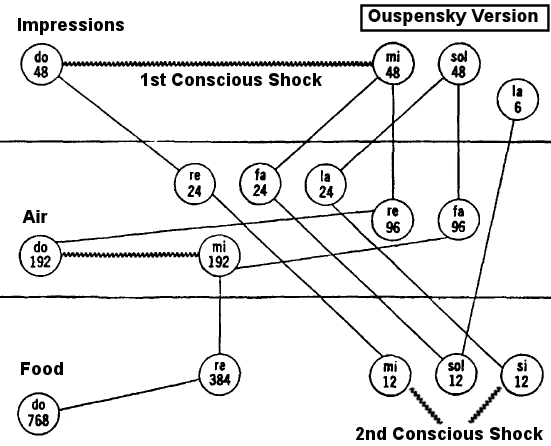
A more significant appearance of the Tarot takes place in the subtext where it is nearly invisible. However, by extracting what is said about the Tarot in this passage, vital information about the composition of the novel can be gained. When Nick discovers that Gatsby’s domestic help has been replaced because of Daisy, he says “So the whole caravansary had fallen in like a card house at the disapproval in her eyes.” What shifts this passage into something beyond cliche is that the words offer P. D. Ouspensky’s name in code: house...disapproval...in...eyes. The code in this instance is particularly demanding, for the K in the name is shifted back to “caravansary” and “card.” Ouspensky‘s “card house” is the design in his essay The Symbolism of the Tarot, where he presents the idea for an arrangement of the entire pack of Tarot cards discussed below in Appendix 3. A caravansary is an inn with a courtyard. We must take into consideration that Fitzgerald says, “whole caravansary.” Thus, the “whole caravansary” corresponds to the figure that is a design for the Tarot cards to be spread as an expression of totality, just as Ouspensky outlines. Ouspensky’s design is not without an origin and may be seen in Basil Valentine’s alchemical text, Twelve Keys. Fitzgerald has brought Ouspensky in to establish a link between the Tarot cards and alchemy. Fitzgerald’s wrote The Great Gatsby by laying out Tarot cards and alchemical emblems in the design that Ouspensky shows in The Symbolism of the Tarot. How exactly this was accomplished remains a mystery. Using only Tarot cards Marjorie Kinnan Rawlings wrote her novel, The Sojourner (1953), in strict compliance with Ouspensky’s divinatory scheme. It was impossible for Fitzgerald to follow Ouspensky’s spread of the Tarot, as once he introduced alchemical emblems to his novel, there was no pre-existing assembly of suits and ranks to follow as there is with the deck of Tarot cards. It seems likely that the outline fore the novel came first, and the esoteric imagery was later applied to the episodes in the text. However, this assertion is speculative.
The characters are at certain points identified with specific Tarot cards. Some of the descriptions in the text are drawn from the imagery on the cards. However, Fitzgerald was not as dependent on the cards for imagery as was Van Vechten who adhered minutely to the scenes on the cards. Gatsby begins with Nick as Judgement. Nicks’ association with the Judgment card is ironic, in that he states that he does not judge:
In consequence, I’m inclined to reserve all judgements, a habit that has opened up many curious natures to me and also made me the victim of not a few veteran bores. The abnormal mind is quick to detect and attach itself to this quality when it appears in a normal person, and so it came about that in college I was unjustly accused of being a politician, because I was privy to the secret griefs of wild, unknown men.
Gatsby’s house is The Tower. “The one on my right was a colossal affair by any standard—it was a factual imitation of some Hôtel de Ville in Normandy, with a tower on one side, spanking new under a thin beard of raw ivy, and a marble swimming pool, and more than forty acres of lawn and garden. It was Gatsby’s mansion.” Tom Buchanan is The Fool. Daisy is the Fool’s Journey and must travers the 22 cards of the Major Arcanum. George Wilson is The Hierophant. Gatsby’s father is The Hermit. At one point Fitzgerald equates Gatsby and Daisy to The Lovers trump card. This significant Tarot card is called out in a coded paragraph:
As I watched him he adjusted himself a little, visibly. His hand took hold of hers, and as she said something low in his ear he turned toward her with a rush of emotion. I think that voice held him most, with its fluctuating, feverish warmth, because it couldn’t be over-dreamed—that voice was a deathless song.
The pattern of identifying the surface action with Tarot cards using the cabala code and secondary clues is followed throughout the entire novel. The impression is that every paragraph in the novel sustains hidden code or esoteric wordplay.
Alchemical Emblems
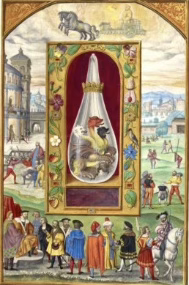
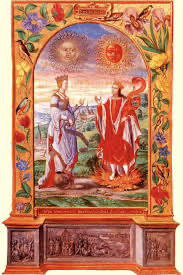
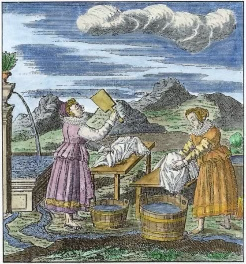
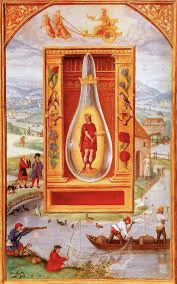
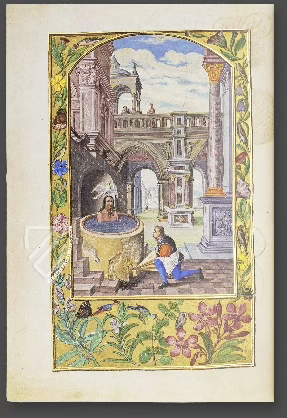
Fitzgerald uses 18 alchemical emblems in Gatsby. Van Vechten has 19 in The Blind Bow-Boy. Fitzgerald shares Van Vechten’s sources, with most of the images coming from the Splendor solis. In both novels the alchemical emblems correspond to the spiritual development of the protagonist. The most developed alchemical motif in Gatsby is that of Daisy and washing. Following the chaos or massa confusa of the nigredo stage, the alchemist undertakes a purification in albedo, which is literally referred to as ablutio – the washing away of impurities. Gatsby does not use his pool until the death scene. This cleansing phase is concerned with bringing light and clarity to the prima materia (the First Matter). When Daisy arrives for the initial tryst with Gatsby at Nick’s house, she is soaking wet. Daisy later wants five bathtubs for cold baths in the city. However, she does not bathe in the hotel and frivoulously jokes that they should send out for an axe to let in more cool air. Washing brings in one of the emblems from Splendor solis that shows a man bathing in a courtyard.
The alchemical emblems used by Fitzgerald are as follows:
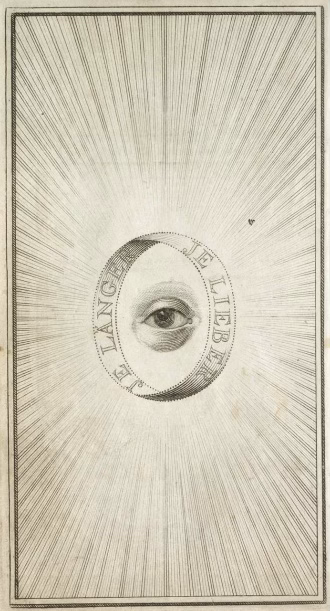
Jakob Boehme, All-Seeing Eye
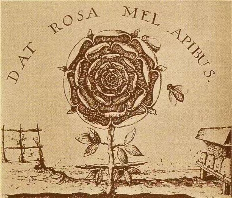
Absolute Rose, Alchemical Rose
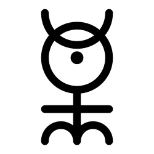
Monas Hiereoglyphica, John Dee
Splendor Solis, three lions
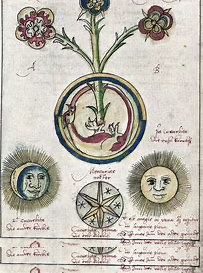
Splendor Solis, lunar queen, solar king
Pretiosissimum Donum Dei, George Aurach, 1475 (albedo)
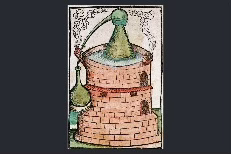
Distillation (alchemical stove)
Coagulation (alchemy)
Washing (alchemy, ablutio, Splendor Solis, women washing clothes)
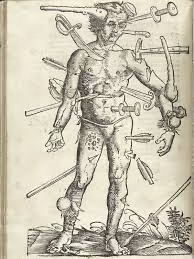
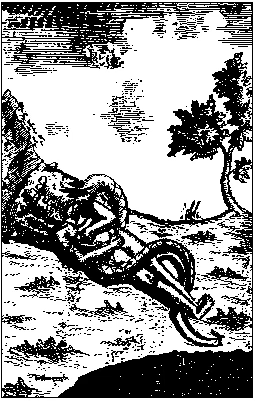
Wound Man
Splendor Solis, red king
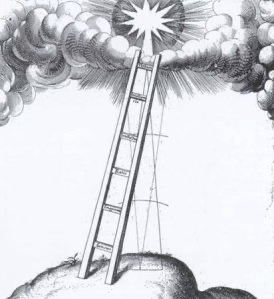
Ladder, Fludd
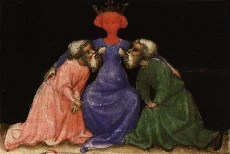
Aurora Consurgens, nursing old men
“Pandora,” Reussner, 1582
Eleazar, King and snake
Splendor Solis, bath
Splendor Solis, lunar queen, solar king (2)
All-Seeing Eye
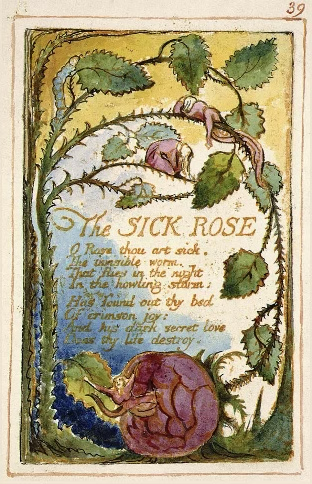
“The Sick Rose,” William Blake
The alchemical emblems in The Great Gatsby are accounted for by a complex system of textural clues that are made even more difficult to penetrate by the cabala code. For instance, William Blake’s poem and drawing, “The Sick Rose” comes into the narrative as Gatsby returns home after Myrtle has been killed, “as he found what a grotesque thing a rose is.” The entire paragraph spells Blake’s name but uses C for K. “[W]arm” is worm in the way of a helpful clue. Fitzgerald’s employment of alchemical emblems is specified by various means in the text. It is a consistent practice that the emblems are both named and symbolized simultaneously as was shown above in the case of Blake’s rose.
Original Emblems
One of the most extraordinary aspects of the emblematic novels is the degree to which they are not recognized for what they are. Carl Van Vechten’s The Blind Bow-Boy was originally published with a distinctive frontispiece by George Locher. This indispensable artwork was not included in the recent republication of the novel. Instead, the cover shows Van Vechten in a portrait by Florine Stettheimer in support of the prevailing camp interpretation of his novel. The Locher frontispiece may usefully be thought of as a crucially important original alchemical emblem, for lacking this paratext Van Vechten’s novel is nearly indecipherable. Locher’s illustration is carried out in a green line drawing, alluding to the green language, another name for the cabala code. The drawing depicts a garden in which a fountain dominates the space. The fountain sits in a D-shaped pool of water, which alludes to the occultist John Dee. John Dee’s Hieroglyphic Monad makes an appearance in Gatsby, where the paragraph encodes the name Dee and registers the hieroglyph that resembles a cartoon smile. Thus, Fitzgerald plays off Dee’s actual symbol against Van Vechten’s inauthentic and less imaginative presentation.
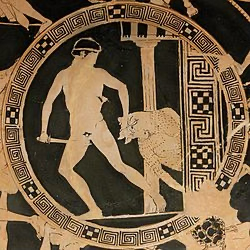
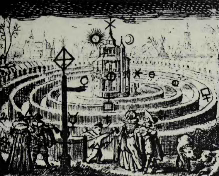
At the center of Locher’s fountain are two sculptural figures, a reclining nude woman and a winged nude man with a bow. The man is wearing a blindfold, and his head is on backwards. We are given enough clues by the title of the novel and the sculptural figures to recognize that this is a depiction of the mythic story of Cupid and Psyche. However, it was Psyche who wore the blindfold in the myth, and Cupid did not have a backwards head. There are many other inclusions in the drawing that lead one into other avenues of allusion. The mistakes in the drawing come under the heading of what Gurdjieff called “lawful inexactitudes,” one of the attributes of “objective” works of art. These intentional departures from reality are used in esoteric texts to indicate the esoteric nature of the exposition. When one follows up the clues in the rest of the Locher drawing a great deal of information is acquired. What we want to do now that we are aware of the intertextual interplay between the two authors using emblems is to look at Fitzgerald’s novel The Great Gatsby with the Locher frontispiece in mind. In The Great Gatsby Fitzgerald parallels Van Vechten’s indulgence in Greek myth by extending the myth of Theseus and the Minotaur throughout his novel. The myth is hard to trace because the elements appear in unexpected locations. We never see Daisy-Ariadne give the string to Gatsby-Theseus, so we are not surprised by Gatsby’s failure to negotiate the labyrinth.
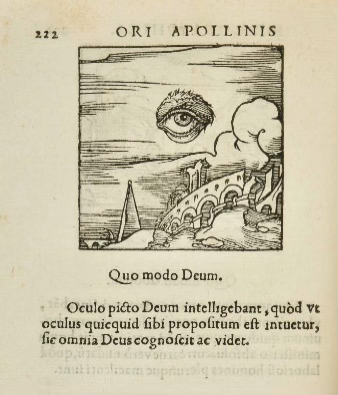
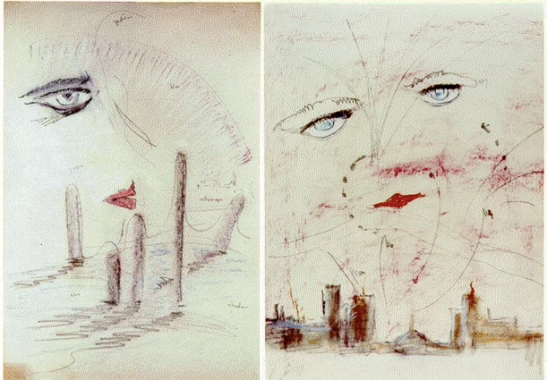
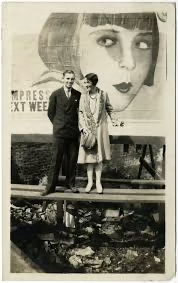
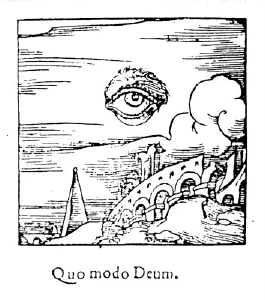
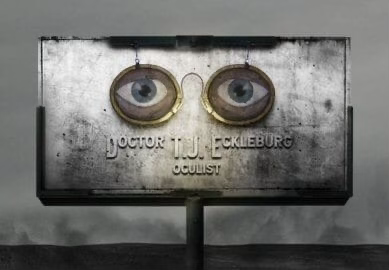
The first of the two original emblems that Fitzgerald inserted into his novel is the advertisement for an oculist in the valley of ashes. What T. J. Eckleburg’s sign has in common with Van Vechten’s paratextual emblem is the focus on vision. Van Vechten’s Cupid is blindfolded, while the images on both of Fitzgerald’s signs have to do with eyes, one showing a pair of gigantic eyes peering through lenses, the second the billboard that Nick and Jordan pass in the city showing a disembodied woman’s face. A variation of the billboard emblem showing the woman’s face designed by Francis Cugat was used on the dustjacket of the novel and on the custom half morocco clamshell boxes that housed deluxe editions. On the dustjacket, the billboard sign has been reduced to mascaraed eyes and ruby lips that float above the bright lights of the city, so that it is no longer a billboard advertisement. What is significant in all of this is that Fitzgerald has derived from Van Vechten the idea of creating an original emblem associated with the theme of vision. Fitzgerald’s cover is derived from a specific alchemical emblem, a 17th century woodcut that shows one eye floating above a settlement.
All-Seeing Eye. Alchemical Woodcut.
A comparison of the Cugat sketch of the face in profile to the alchemical all-seeing eye woodcut shows a striking resemblance. Cugat even carries over to his sketch the woodcut’s tower and the rounded shape of the arches in the walls.
Francis Cugat’s sketches for the cover of Gatsby.
On the surface, neither of Fitzgerald’s emblems appear to be connected to myth in the same way as Van Vechten’s Cupid and Psyche emblem. However, just as the Cupid wears the misplaced blindfold, the lawful inexactitude in Gatsby is a visual error (or conscious discrepancy). While both signs bear two eyes peering through spectacles due to the need for correction, what pertains to alchemy is the all-seeing eye. Where there are two corrected eyes, there should properly be one all-seeing eye. This idea has been made yet more distant on the cover of the book where the presence of lips goes even further toward the depiction of a face. The argument can even be made that just as Van Vechten has inserted Cupid and Psyche into his emblem, Fitzgerald’s emblem presents Gatsby and Daisy as the oculist’s sign (Gatsby) and the billboard face (Daisy) respectively. Burrows points out that Cugat has inserted a naked woman into the pupils of the two eyes on his cover: it can be added that this device echoes the insertion of the coded subtext that Fitzgerald has made an open secret in his coded novel with an ever-present key. The exploration of the oculist’s billboard motif comes to a head in the dialogue between George Wilson and Mavro Michaelis over the meaning of the oculist’s sign. Wilson sees God in the sign, implying the absent all-seeing eye. Michaelis sees the sign for what it is materially, a commercial advertisement.
Gatsby’s death marks Fitzgerald’s creation of another original alchemical emblem. Alchemy is so important to the structure of Carl Van Vechten’s novel, The Blind Bow-Boy, that the protagonist, Harold Prewett is named after the hard wet alchemical method. The hard wet method is described in an alchemical document called The Twelve Keys of Basil Valentine. The Valentine document features twelve alchemical emblems called keys. The Twelve Keys of Basil Valentine’s eighth key contributes heavily to a lengthy and important chapter in Van Vechten’s novel, the visit to Coney Island. Fitzgerald, who used Van Vechten’s novel as a model for Gatsby, used alchemy to structure his novel more closely than did Van Vechten. Following Van Vechten’s use of The Twelve Keys of Basil Valentine Fitzgerald’s description of Gatsby’s corpse floating on a mattress in his pool is a rendering of the seventh key (VII. Clavis) from The Twelve Keys of Basil Valentine series of emblems.
The emblematic novel Is not a recognized genre, so It Is not surprising that the emblem that Fitzgerald assembles through the imagery in this scene remains concealed. Contributing to the difficulty is the abstract language that appears to be a detailed description of the scene of Gatsby’s death:
There was a faint, barely perceptible movement of the water as the fresh flow from one end urged its way toward the drain at the other. With little ripples that were hardly the shadows of waves, the laden mattress moved irregularly down the pool. A small gust of wind that scarcely corrugated the surface was enough to disturb its accidental course with its accidental burden. The touch of a cluster of leaves revolved it slowly, tracing, like the leg of transit, a thin red circle in the water. It was after we started with Gatsby toward the house that the gardener saw Wilson’s body a little way off in the grass, and the holocaust was complete.
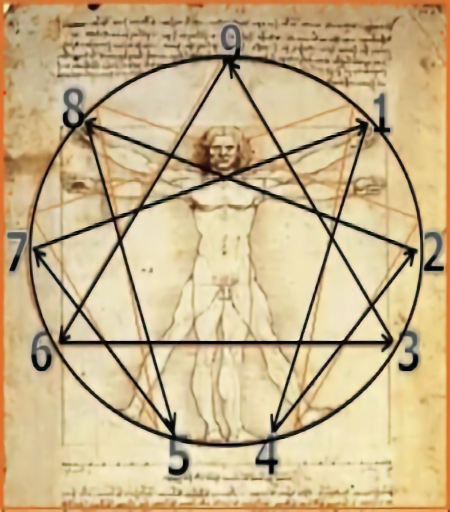
In this expressive, chiming passage, Gatsby is reduced to being only what the mattress is laden by; he is not shown. Fitzgerald concentrates on Gatsby’s surroundings, which are given an illusory clarity through the numerous details cataloged in the passage. If the plan of this description is filled out and normalized in the way of a realistic commentary, we are still left wondering why the circle is drawn with a transit instead of a compass, which is the tool used to draw a circle. Placing this scene in a graphic context, the red circle that surrounds Gatsby floating on his square mattress means that he is arranged exactly like Leonardo da Vinci’s Vitruvian Man. The cabalistically-coded way that we are forced to read this esoteric novel, brings the phrase “transit, a thin red circle” into one semantic unit, which names a device known as the transit circle. The transit circle is a wheel on a telescope used to raise and lower the instrument.
Fitzgerald introduces the transit circle to summon the imagery of the enneagram, a circle with nine equidistant points on its circumference, a figure that was central to the Gurdjieff Work, where it is linked to the Law of Seven and the Law of Three. Thus, Gatsby is not only squaring the circle as the ideal Vitruvian man, but he is also centered on the enneagram/transit wheel.
The Enneagram-Vitruvian Man Emblem
In the discussion of the Tarot above, we saw that Ouspensky discourses on a spread of the entire Tarot deck on a triangle within a square. The origin of Ouspensky’s figure is not from the Tarot but from alchemy. However, the identification of Ouspensky’s spread gives Gatsby’s emblematic depiction in the pool a relation to the Tarot as an expression of the Absolute as well as to alchemical perfection.
Alchemy in The Great Gatsby
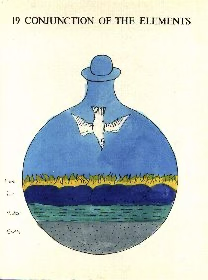
Alchemy is a secret body of knowledge concerned with the gaining of a treasure. In summary, though a definitive count is difficult, thousands of alchemical manuscripts and books are known to exist, reflecting a textual tradition that spans from ancient times to the present day, with particularly significant periods in late antiquity, the medieval Islamic world, and Renaissance Europe. Whether the treasure is wealth or enlightenment depends upon the understanding of the seeker. The secrets of alchemy are protected by codes and ambiguous graphic images. What has been recorded in this way are the processes that must be used to produce the treasure. The processes are called the Great Work. As alchemy is a secret process, the exact method is an unknown. The stages of the process, the order of the stages, and the number of stages varies from text to text, though most agree that there are at least four, Nigredo, Albedo, Citrinitas and Rubedo. One hundered and ten (110) alchemical processes have been named, though most schemes stop at seven: Calcination, Dissolution, Separation, Conjunction, Fermentation, Distillation, and Coagulation.
The passage that has summoned the controversy about Gatsby’s race is the most tangible manifestation of alchemy in The Great Gatsby: “As we crossed Blackwell’s Island a limousine passed us, driven by a white chauffeur, in which sat three modish negroes, two bucks and a girl. I laughed aloud as the yolks of their eyeballs rolled toward us in haughty rivalry.” Fitzgerald has used the cabala code to stretch the word alchemy across the span of the twenty-four words quoted above. The nigredo stage of alchemy is an inescapable assignment given the declaration by the text that alchemy is being addressed. The nigredo phase, or blackening, represents the initial stage of transformation, often symbolized by darkness, putrefaction, and decomposition. The alchemical engraving from Theatrum Chemicum (1613) below is an illustration of the nigredo phase. The raven symbolizes this initial, black stage of transformation, representing the dark matter that needs to be transformed. The alchemist's corpse with the raven, symbolizes the spiritual death of the practitioner.
Fitzgerald has rendered the nigredo emblem in his narrative as a limousine containing two African-American men and a woman. The complex intertextuality at play in this passage relates the narrative action where Gatsby and Tom vie for Daisy with the process of alchemy that breaks down the defenses that have formerly sustained the characters. To guide the reader to these complexities Fitzgerald has inserted two lawful inexactitudes into the passage, the eyes of the African-American men having yolks instead of whites and the reversal of social norms whereby a white driver works for an African-American.
The use of the word chauffeur is yet an additional pointer to alchemy, since the origin of the word chauffeur is stoker. Alchemists are stokers of the athanor, the alchemical furnace. And the word chauffeur also means to heat. The nigredo stage involved the heating and cooking of substances, often in a furnace or similar vessel. (Inescapably, the valley of ashes calls up the nigredo phase with its suggestion of the presence of the fires that have produced the monumental heaps of residue.) This was believed to cleanse the material and reduce it to a uniform black matter before further transformation could occur. One of the chief mysteries of alchemy was the identification of the black mass (prima materia, first matter) that was to be processed into the Stone. The furnace in this context is a tool for applying the intense heat needed for this initial stage of breakdown and purification. The alchemical furnace enters the novel with the “stove” and “tears,” when Gatsby and Daisy meet at Nick’s house for the first time. Distillation was often referred to as sublimatio in alchemical terms, which describes the symbolic process of how a base substance is transformed into a higher substance through an ascending movement. “The Work, the name by which Gurdjieff’s teachings are most usually known, is drawn from alchemy, where the Great Work signified the refinement and purification of base metals into gold as well as the transmutation of the soul into a higher spiritual state. Gurdjieff's teachings similarly aimed at the transformation of man's inner substance. Through cosmological speculations, through lectures, manual work, communal life, and sacred dances or 'Movements' in successive phases of his life, Gurdjieff offered a practical form of esoteric instruction that could harmonize the microcosm of the human being with the macrocosm of the universe and so reunite man with the Endlessness or supreme deity.”
Thus, whatever may be true about Gatsby’s race, the imposition of alchemy onto the narrative has made the surface text markedly ambiguous. It is only by recourse to the coded subtext and to the symbolic subtext of emblems that any assignment can be made to the semiotic contents of the novel. Fitzgerald shows the reader the sequence of alchemical stages through the colors of objects, just as the colors follow in the correct order. It is much more difficult to access the Sixteen (16) alchemical emblems presented in the novel, for it is not obvious that they are present. The existence of the alchemical emblems must be discovered through close examinations of the text and a knowledge of a wide range of lore. For instance, even though Daisy makes an odd declaration, there is no reason to associate what she says with alchemy. Daisy says, “I love to see you at my table, Nick. You remind me of a—of a rose, an absolute rose. Doesn’t he?” She turned to Miss Baker for confirmation: “An absolute rose?” Daisy is supposed to be shallow, so there is no reason to see her use of “absolute” as anything beyond exaggerated showing off. Daisy is used to allude to the alchemical rose. The closed petals and hidden core of the rose symbolize the hidden nature of alchemical knowledge and the secret process of transformation. The rose is seen as a symbol of the alchemical "Great Work," the journey of personal transformation and the attainment of spiritual enlightenment.
The Complete Emblematic Contents of The Great Gatsby
Judgement
The Tower
The Fool
The Fool’s Journey through all the Trumps. [Daisy as “The Little Fool”]
The Moon
The Devil
Jakob Boehme, All-Seeing Eye
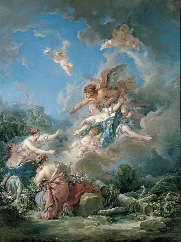
Boreas Abducting Oreithia, Boucher
The Sun (reversed)
Absolute Rose, Alchemical Rose
Four of Swords (reversed)
H.P. Blavatsky (photograph)
The Terminal (1893), photograph by Alfred Stieglitz
Alfred Stieglitz/Georgia O’Keeffe (photographs)
Jean Toomer (photograph)
The Moon
P. D. Ouspensky (photograph)
Justice
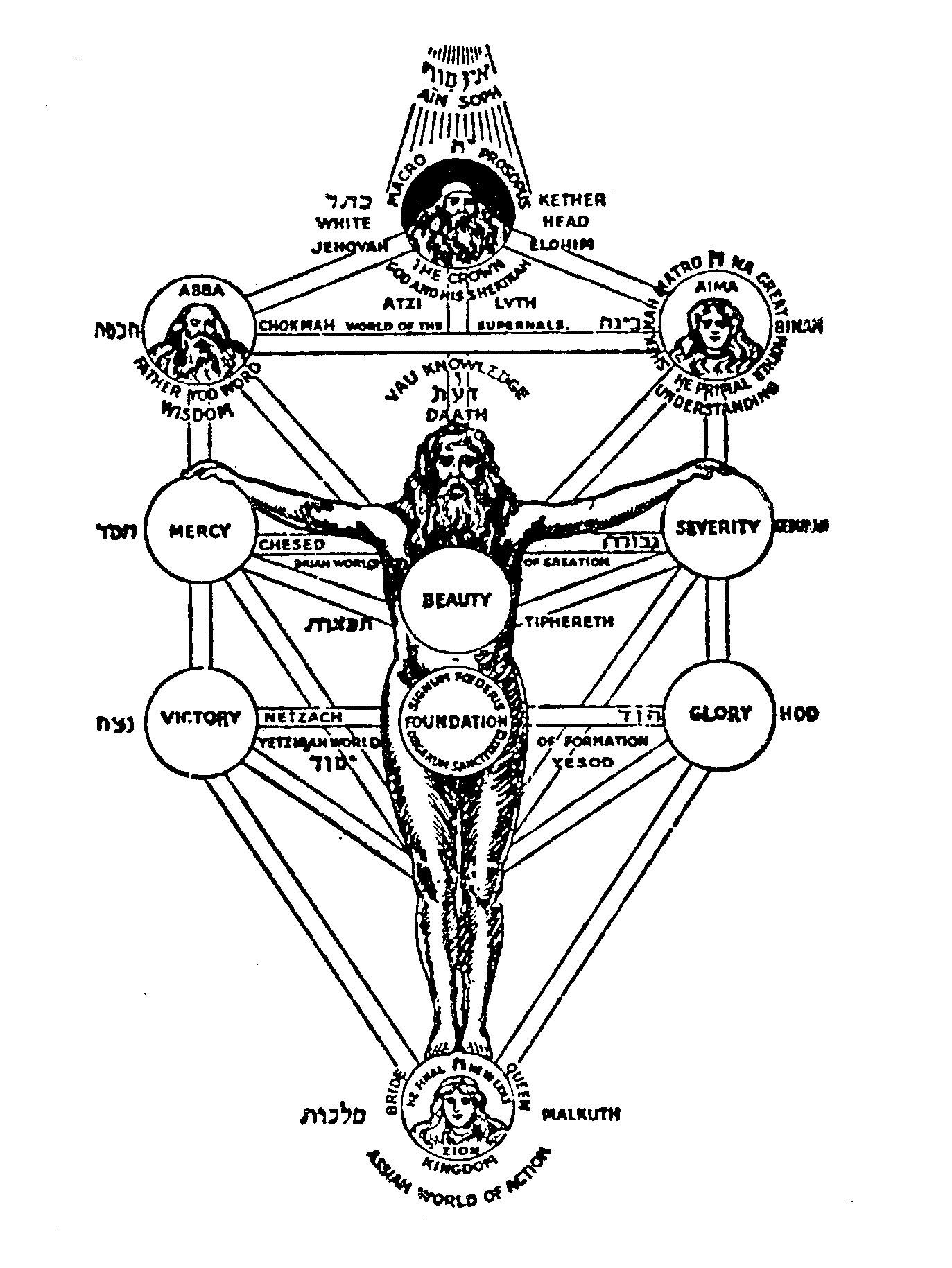
Adam Kadmon
Monas Hieroglyphica, John Dee
The World
Wheel of Fortune
The Sun
The Chariot
Minotaur-Alchemical Labyrinth
Medal
Gurdjieff (photograph)
White Card
Four of Wands
Seven of Swords
Wheel of Fortune (upright)
Splendor Solis, three lions
Splendor Solis, lunar queen, solar king
Billboard Face (photograph)
The World
Six of Cups
Pretiosissimum Donum Dei, George Aurach, 1475 (albedo)
Trench (WW1 photograph)
Daisy’s Cocked Beaver Hat (photograph)
Seven of Cups
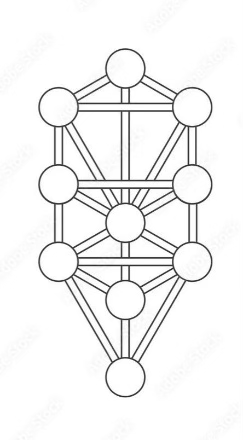
Tree of Life (Sephirot, Ain Soph)
Distillation (alchemical stove)
Coagulation (alchemy)
Washing (alchemy, ablutio, Splendor Solis, women washing clothes)
A.R. Orage (photograph)
Carl Van Vechten (photograph)
Zora Neale Hurston (photograph)
Muriel Draper (photograph)
Wound Man
Splendor Solis, red king
The Lovers
Strength
Death
King of Swords
The Star
Ladder, Fludd
Aurora Consurgens, nursing old men
“Pandora,” Reussner, 1582
Three of Wands
Eleazar, King and snake
Splendor Solis, bath
The Hierophant
Splendor Solis, lunar queen, solar king (2)
Shock Diagram
Two of Cups
Four of Swords
Knight of Cups
The Last Judgement
Two of Wands
All-Seeing Eye/Ad Sign
Five of Cups
“The Sick Rose,” William Blake
Vitruvian Man-Enneagram
The Hermit
The Star
The Hierophant
Thyra Samter Winslow (photograph)
e. e. cummings (photograph)
Jon Woodson, “Tear down the log cabin”: Marjorie Kinnan Rawlings’s The Sojourner as a High Modernist Novel Based on the Tarot and Written in Collaboration with Zora Neal Hurston” (2014).
Fitzgerald, The Great Gatsby, p. 7.
Fitzgerald, p. 176.
Fitzgerald, p. 99.
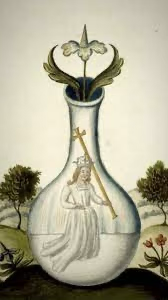
I have shown the alchemical emblems due to their unfamiliarity. The other materials can be easily obtained on the internet.