The names in Nick Carraway’s list of Jay Gatsby’s are not of a piece. The names are invested in various forms of satirical wordplay (name-calling, exaggeration, parody, non sequitur) but only some of them conform to the rules of the cabala code. It could be suggested that the most important name on the extensive list is Ripley Snells. This name is to be deciphered as smells ripe. It can be noticed that the words are read in the reverse order and some letters must be substituted, others are ignored, and that the only reason sense can be made of the original form is because smells ripe is a cliché. The cabala asks the reader to perform these gymnastics with words that are unfamiliar: this is the source of the difficulty of reading the green language of alchemy. Another name in the same pattern is Lester Myer, which says more or less. Edgar Beaver follows this pattern. Fitzgerald’s examples imply the rules of the code.
All of the names of people in the novel take the encoded form that was demonstrated above. An annotated list of the deciphered names follows:
Nick Carraway. Fitzgerald’s narrator continues to remain controversial among analysts of the novel. This is because of the contradictions introduced by this crucial focalizer. The name Nick stands on its own and does not need to be deciphered. Carraway uses the cabala code to say awake. It is within the rules of the cabala to shift the position of the c, to make it a k, and to ignore the remaining letters. These necessities allow for the impenetrability of the coded language, as conventional reading disallows these procedures. Awakening is a determining concept to attach to Nick and to the novel, as it is the central impetus of the Gurdjieff Work that the normal state of man is a waking sleep. Ouspensky’s summation of the Work states that
But of course most sleeping people will say that they have an aim and that they are going somewhere. The realization of the fact that he has no aim and that he is not going anywhere is the first sign of the approaching awakening of a man or of awakening becoming really possible for him. Awakening begins when a man realizes that he is going nowhere and does not know where to go. (In Search of the Miraculous 159)
It is no exaggeration to say that the above quotation fully expresses the submerged esoteric theme of The Great Gatsby. Gurdjieff’s 1,000-page novel Beelzebub's Tales to His Grandson or An Objectively Impartial Criticism of the Life of Man uses the framing device of the musings of an extraterrestrial known as Beelzebub (who shares a name with the demon of the same name) to his grandson Hassein, as they travel through space towards Beelzebub's home planet, Karatas, on the spaceship Karnak. Beelzebub recounts his adventures and travails amongst the "three-brained beings" (humans) of the planet Earth. Beelzebub details the history, customs and psychology of humanity and relates the esoteric theory behind the workings of the universe. One of the more common colloquial names for the Devil is Old Nick. Given that the narrator is given the name Nick, we can see that Nick Carraway exists in some relationship to the descent of Beelzebub to Earth. If Nick Carraway is the fully awakened extraterrestrial Beelzebub, the narrative takes on a complex esoteric meaning. For instance, Nick begins by saying that he does not judge, a statement that flies in the face of the title of Gurdjieff’s novel, An Objectively Impartial Criticism of the Life of Man.
It should also be noted that Nick’s list of Gatsby’s guests concludes with a tongue-in-cheek disclosure of his identity as Beelzebub. Nick writes that one guest was “a prince of something, whom we called Duke, and whose name, if I ever knew it, I have forgotten” (Fitzgerald 41). The something Nick leaves unsaid is the prince of darkness, and Satan is also known as the Great Duke. In a connected revelation, Nick says that his family descends from the Dukes of Buccleuch (Fitzgerald 49), again referring to the Great Duke. While Buccleuch is an orthographic departure from Beelzebub, the word descended suggests the six descents that Beelzebub made to Earth. Nick Carraway has not forgotten his own name, Beelzebub, and now we have a measure of his absolute untrustworthiness as a narrator.
Jay Gatsby. Jay Gatsby’s name at birth was James Gatz. His father called him Jimmy when he came to Gatsby’s funeral. As Jimmy Gatz climbed aboard the yacht Tuolomee, he became Jay Gatsby. The name used by Fitzgerald is an incorrect spelling of Tuolumee. The introduction of this mistake a (also known as a conscious discrepancy or lawful inexactitude), identifies the existence of an esoteric content. When Tuolumee is read in reverse and sounded phonetically, it says emulate. It has been well established that Gatsby wished to join the upper class, and that he used his employment with Dan Cody to learn the ways of the wealthy. Emulate is there to make a distinction from imitation. The initiate must find his own way.
Reading Jay Gatsby through the cabala code’s phonetic variations produces gate. The whole name Jay Gatsby is strait gate. This brings us to Mattthew 7:13-14 (King James Version)
13 Enter ye in at the strait gate: for wide is the gate, and broad is the way, that leadeth to destruction, and many there be which go in thereat:
14 Because strait is the gate, and narrow is the way, which leadeth unto life, and few there be that find it.
The relevance of the strait gate is established when Gatsby’s father shows Nick the self-improvement schedule that Gatsby wrote on the blank pages of Hopalong Cassidy. The mystery of introducing a wild west adventure story into Gatsby is countered by recollecting that the cowboy hero had a wooden leg and a strong moral compass. The wooden leg marks the indirect insertion of a legominism, a text within the main text in which fundamental concepts in the Fourth Way (the Gurdjieff Work) are presented. The standard method for introducing a legominism in Van Vechten’s novels was to diffuse the word legominism through separated units: “donned…dressing-gown…legs…swimming” (Van Vechten 154). Van Vechten also supported the above clue with the words “green” and “writing,” a reference to the green language, another name for the cabala. Fitzgerald chose to only use the word leg. In this case, the leg appears indirectly, which accounts for the obscurity of the role of the esoteric in The Great Gatsby.Since the preliminary stage of the Work is self-observation, we may think of Gatsby’s youthful regimen as an approximation of the course of self-observation taught by A. R. Orage.
Daisy Fay. We can best understand Daisy Fay through the esoteric doctrine of the Law of Three, one of Gurdjieff’s fundamental teachings:
The Law of Three is a law of creation. Creation of the human life. The law states that for anything to be created or an event to materialize three forces must be present. An active force (father), a passive force (son), and then a neutral force (holy-spirit). All three must be present and are equally important for the phenomenon to arise. A simple example would be boy meets girl, the active force, boy wants the girl, but the girl doesn’t want the boy because he is out of shape and overweight, the passive force. The boy decides to start eating better and exercising, the neutral force, to get in shape and impress the girl. Boy and girl get married and live happily ever after, the outcome or manifestation of the three forces. (Decker)
The example above approximates the plot of The Great Gatsby. Instead of diet and exercise, the novel applies Gatsby’s mansion, parties, and wealth as the neutral force, though the rejection is complicated by the fact that it is all in Gatsby’s head. The term appearing above in connection with the girl is passive. Daisy’s name is code for easy. Daisy is the passive force, she is easy.
Tom Buchanan. Tom Buchanan is also best understood through the Law of Three. Fitzgerald has manifested the denying aspect of the second force through Tom. Tom Buchanan is code for you can not. It goes without saying that ordinarily we do not read Tom as the word not, which is why the cabala functions so well as code.Tom’s role in the narrative is to opposes nearly everything that the action introduces. Later he is directly in opposition to Gatsby. It is Tom who provides the misleading information that incites Gatsby’s murder by George Wilson.
Myrtle Wilson. Myrtle is code for murder. Myrtle is murdered by Daisy Buchanan using Gatsby’s car. This literal treatment of names is common in many other Oragean Modernist novels, where characters are given descriptive, coded names. Where Myrtle evokes an esoteric concept is through her fascination with a dog. On an impulse, Myrtle purchases a puppy, which she ignores unless to impulsively cover it with kisses. The dog is met in the Gurdjieff Work through the warning to pupils that if they did not perfect themselves, they will “die like dogs” (Wellbeloved).
George Wilson. George Wilson’s name says no will. According to Nick Carraway, “He was a blond, spiritless man, anaemic, and faintly handsome” (Fitzgerald 20). Will is one of the ideas in the Work that powerfully informs Fitzgerald’s novel, since what we are shown are the various outcomes of the exercise of will. Ouspensky states that
What happens or may happen to us may depend upon three causes: upon accident, upon fate, or upon our own will. Such as we are, we are almost wholly dependent upon accident. We can have no fate in the real sense of the word any more than we can have will. If we had will, then through this alone we should know the future, because we should then make our future, and make it such as we want it to be. If we had fate, we could also know the future, because fate corresponds to type. If the type is known, then its fate can be known, that is, both the past and the future. But accidents cannot be foreseen. Today a man is one, tomorrow he is different: today one thing happens to him, tomorrow another." (In Search of the Miraculous 100-101)
We can abstract from the above quotation that what we see in Gatsby is the determination to overcome accidents and to make his future what he wants it to be.
Meyer Wolfsheim. The leader of the criminal gang through which Gatsby made his money is the embodiment of Gurdjieff in the novel. Gurdjieff is always depicted negatively by A. R. Orage’s followers. The repudiation of Gurdjieff is signaled in The Great Gatsby by the repeated mention of Wolfsheim’s protruding nose hair: “A small, flat-nosed Jew raised his large head and regarded me with two fine growths of hair which luxuriated in either nostril. After a moment I discovered his tiny eyes in the half-darkness” (Fitzgerald 44). This usage is in contradistinction to Gurdjieff’s flourishing moustache which never goes unremarked in any account of the figure. Despite this belittling treatment we must recognize that Meyer Wolfsheim’s name can be deciphered as follow me, a phrase inextricably linked to Jesus. As the followers of Orage embraced Gurdjieff’s teaching while divorcing themselves completely from Gurdjieff the man, we must assume that Wolfsheim takes the place of a false messiah, and he must be rejected. The only action that Wolfsheim takes is to refuse to attend Gatsby’s funeral, thus we witness his depravity. Nick Carraway finds Wolfsheim through locating the Swastika Holding Company. The symbol of the swastika is of no importance in this case, serving only the purpose of coding the language. We can read Swastika Holding Company superficially as waste land. In other words, Gurdjieff the man, is a dead end. However, there is a pornographic decoding that is more likely, since it absorbs all the elements of the name. See the Swastika Holding Company footnote 174 above.
Doctor T. J. Eckleburg. Though he is not a living character, Doctor T. J. Eckleburg is a major contributor to the meaning of the text. The sign is the most tangible emblem in what is an emblematic novel. Most of the other emblems are present only through allusions, such as when at the opening of the novel Nick Carraway brings in his “[inclination]to reserve all judgements” (Fitzgerald 7), which brings in the Judgement Tarot card. The name appears on a sign that dominates the skyline of the valley of ashes. The valley of ashes is as important a setting as Gatsby’s mansion. Much of the action of the novel seesaws between the vitalic chaos of Gatsby’s mansion and the sterility of the valley of ashes. However, the valley of ashes would lack most of its significance were the oculist’s sign not present:
But above the grey land and the spasms of bleak dust which drift endlessly over it, you perceive, after a moment, the eyes of Doctor T. J. Eckleburg. The eyes of Doctor T. J. Eckleburg are blue and gigantic—their retinas are one yard high. They look out of no face, but, instead, from a pair of enormous yellow spectacles which pass over a nonexistent nose. Evidently some wild wag of an oculist set them there to fatten his practice in the borough of Queens, and then sank down himself into eternal blindness, or forgot them and moved away. But his eyes, dimmed a little by many paintless days, under sun and rain, brood on over the solemn dumping ground.
Gurdjieff had a sallow complexion, and there is hardly a work of fiction by the Oragean Modernist school where his representations are not associated with the color yellow. So, we can take the doctor as a depiction of Gurdjieff. This is seconded by the use of the word oculist, for it is a suggestion of occultist, a word often applied to Gurdjieff.The doctor’s name itself is a puzzling and fragmentary offering of Gurdjieff’s name. Some of the requisite letters are present and must be relocated to come close to Gurdjieff. The T is used to supply the long E sound that is alternatively used to pronounce his name if the speaker desires a more authentically Russian delivery. Thus, we have the name Gurdjieff from gur [urg] D [Doctor] J. E [Eckleburg]. The F is lacking, which does not contradict the usages of the cabala code. As an added clue, the leb taken as bel and combined with E is a suggestion of Beelzebub. The enormous eyes looking through yellow spectacles suggests the remote gaze of Beelzebub who for thousands of years observed humanity though an alien version of a telescope:
“Yes, I must note that by the time to which my tale refers, my first Teskooano had already been set up in the observatory which I had constructed on the planet Mars and I was just then devoting myself entirely to the further organization and development of this observatory of mine, for the more detailed observation of the remote concentrations of our great Universe and of the planets of this solar system.
“Among the objects of my observations, then, was also this planet Earth.” (Beelzebub’s Tales 90)
The identification of the oculist with Gurdjieff’s fictional Beelzebub is sustained by the gigantic retinas on the sign, which give the coded word Satan. The advertisement is an indication of the importance of occultism to the understanding of the novel while also participating crucially in the action. In fact, when Geroge Wilson, devastated by his wife’s death, proclaims that the eyes belong to God, the neighbor who is nursing him declares that it is only an advertisement. The valley of ashes over which the advertisement looms takes its occult meaning from alchemy, for ashes are connected to the processes of transformation and rebirth. The reborn phoenix rises from ashes. The Gurdjieff Work is often said to be a form of alchemy: “besides ordinary chemistry there exists another, a special chemistry, or alchemy if you like, which studies matter taking into consideration its cosmic properties” (Ouspensky 91). The oculist’s sign is in the final analysis a conscious discrepancy, for it stands in place of an alchemical emblem with a cosmic meaning. The authentic emblem bears not two floating eyes but one floating eye, the All-Seeing Eye.
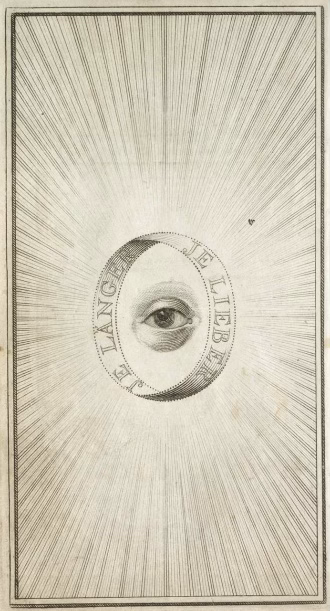
Jacob Boehme. “The longer the better.”
Jordan Baker. Jordan Baker is code for danger/wreck. Nick is alarmed by her nonchalant, irresponsible driving. Jordan replies that it takes two to make an accident (Fitzgerald 39). However, Jordan Baker is only dangerous to Nick Carraway who might have married her. Nick’s retreat from Jordan Baker has set up one of the most pervasive ambiguities in the interpretation of The Great Gatsby. Because we no longer know what sort of being Nick Carraway is, Jordan’s danger only deepens the mystery.
Mr. McKee. On the surface, the photographer Mr. McKee provides the word meek.
Mr. McKee was a pale, feminine man from the flat below. He had just shaved, for there was a white spot of lather on his cheekbone, and he was most respectful in his greeting to everyone in the room. He informed me that he was in the “artistic game,” and I gathered later that he was a photographer and had made the dim enlargement of Mrs. Wilson’s mother which hovered like an ectoplasm on the wall. His wife was shrill, languid, handsome, and horrible. She told me with pride that her husband had photographed her a hundred and twenty-seven times since they had been married.
From the above quotation, we can see that the McKees are satirical portrait of Alfred Stieglitz and Georgia O’Keeffe. In a second scene Nick is shown intervening:
It was nine o’clock—almost immediately afterward I looked at my watch and found it was ten. Mr. McKee was asleep on a chair with his fists clenched in his lap, like a photograph of a man of action. Taking out my handkerchief I wiped from his cheek the spot of dried lather that had worried me all the afternoon.
This seemingly irrelevant episode hides one of the most consequential meanings in the novel. Handkerchief is the only word in the English language which holds the correct phonetic pronunciation of Gurdjieff’s name (gord-chief), which in English is corrupted to gird-chaff. The lather is the word heal in code. The moves that Nick carries out serve as an allegorical pantomime of a foundational cosmic event.
In Beelzebub’s Tales to His Grandson which Gurdjieff introduced a theme that runs as a litany through the entire book the idea of “Kundabuffer.” Kundabuffer was an organ implanted by “archangels” in man “at the base of the spinal column,” whose effect was to make them perceive reality upside-down and to experience “pleasure and enjoyment.” The archangels feared that if people “prematurely” understood their slavery to cosmic purposes and that the reason for their existence was that when they die they were meant to be “food for the moon,” they might “make a great deal of trouble” and even “end their existence.” Kundabuffer was later removed by other archangels, but its “consequences” had become crystallized in Man and are the chief cause why life on earth is so full of evil. (Hodges “Kundabuffer”)
Gatsby’s parties are examples of the ongoing effect of the remains of the buffers that hypnotize the human race. McKees lather dots his face because he cannot observe himself. Nick’s action removes the buffers to self-observation. While it is counterintuitive for Nick-Gurdjieff-Beelzebub to remove the lather so that McKee can see himself, we have also to realize that were Nick to simply show McKee the spot of lather on his face, McKee would not have acted. This is why the text states that even though McKee is asleep he is in the pose of a man of action. Thus, what Nick does is to supply McKee with the possibility to actively self-observe so that he can awaken Stieglitz set himself up as a spiritual teacher rivaling Gurdjieff, and Fitzgerald has demoted him through satire
Mrs. Sigourney Howard. Journey/coward. Daisy uses this person’s house for refuge after the murder.
Dan Cody. Dan Cody says in code. As in all emblematic novels there is a coded indication that the text is written using the cabala code. Anagrams of the word cabala (from other emblematic novels, Calabrese, cable, Cadillac, Gabalis) are a feature of emblematic novels. Fitzgerald has resorted to capable, balance, peculiar, palace, and celebrated for the most accessible renderings of cabala in the cabala code.
Ella Kaye. Ella Kaye is, from the esoteric perspective, the most important name in the novel. The name renders the word key. The name Madame de Maintenon follows in the same sentence, implying the name is a key. The chateau where Gurdjieff established the Institute for the Harmonious Development of Man was the Prieuré near Avon in the Forest of Fontainebleau. The property had originally been a monastic priory of which only a few stones were left in the ground. The Chateau had been built in Louis XV’s time and there every Sunday Mme. de Maintenon went to Mass. It ceased to be a monastery at the time of the French Revolution but kept its name. This coded indirect allusion is as close as Fitzgerald comes in The Great Gatsby to identifying the alignment of his novel with the Gurdjieff Work. However, it is a substantial indication.
Mavro Michaelis. Mavro means black in Greek and suggests a person of poor character. Michaelis is an allusion to the suit of cups in the Tarot through the decoded word chalice from Michaelis. At the same time, the cook—in contrast to George Wilson—seems to uphold the reality principle:
Standing behind him, Michaelis saw with a shock that he was looking at the eyes of Doctor T. J. Eckleburg, which had just emerged, pale and enormous, from the dissolving night. “God sees everything,” repeated Wilson. “That’s an advertisement,” Michaelis assured him. Something made him turn away from the window and look back into the room. But Wilson stood there a long time, his face close to the window pane, nodding into the twilight.
The Tarot card that corresponds to the scene described in the novel is the Five of Cups.
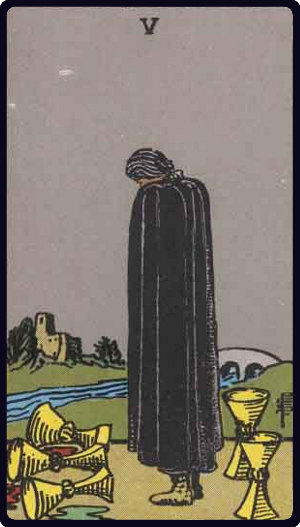
The Five of Cups
“The Five of Cups card portrays a figure cloaked in black, head bowed in sorrow, set against a desolate landscape. Before him, three spilled cups stand, their contents flowing onto the ground” (Waite). It is a card of loss. The name Mavros, black, is explained by the black cloak.
Fitzgerald, p. 19. Fitzgerald, p. 23. Fitzgerald, p. 27. Fitzgerald, p. 98.